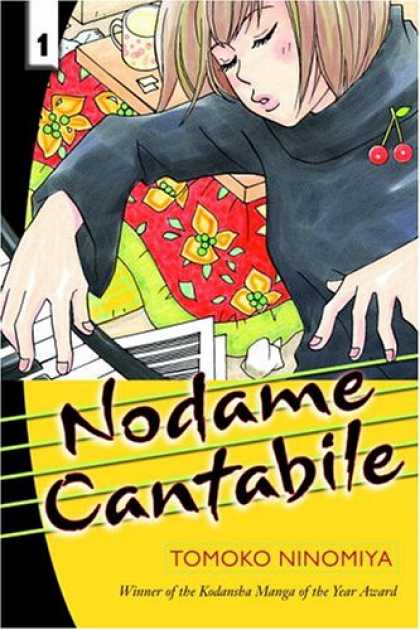
Nodame Cantabile
 won the 2004
Kodansha Manga Award for best
shojo manga. It is currently serialized in Japan's
Kiss publication and has been running since 2001. Considered a
josei manga aimed at young adult women, the story is centered around a group of college students at
Momogaoka Music College.
Megumi Noda, known as
Nodame throughout the series, is an eccentric piano student who wants to be a kindergarten teacher. Although she plays with great passion by ear,
Nodame lacks technical skills such as site reading a score, playing a piece exactly as written, or basic music theory. She lives next door to music student
Shinichi Chiaki, a pianist/violinist who desires to become a conductor. His father being a famous musician,
Chiaki has spent most of his life in the music world, even growing up in Prague. The two students meet by accident, but slowly become acquainted through the piano department.
Nodame falls for
Chiaki in short time, seeing as he often cooks her dinner and helps her practice.
Chiaki slowly develops an appreciation for
Nodame's musical passion and accepts her little quirks. A visiting professor at the school,
Stresemann, decides to challenge
Chiaki by having him conduct a student orchestra. Because of
Nodame,
Chiaki learns how to work with the struggling musicians and is able to make a name for the student orchestra. In hopes of one day playing for
Chiaki as a conductor,
Nodame begins to develop her musical skills and challenges herself to play better. With the help of
Nodame,
Chiaki overcomes a phobia and is able to leave Japan, where he becomes the conductor of a more well known orchestra in Paris.
The strong point of this series is
Tomoko Ninomiya's brilliant ability to create unusual, unique characters. Her main protagonists are far from any stereotypes. The depth of development of
Nodame and
Chiaki, from their backgrounds to their quirks and phobias, really ground this series to a more realistic, believable experience. The two seem far from a compatible couple, with
Nodame's immaturity and
Chiaki's arrogance. Yet, the
mangaka uses these weaknesses as the growth point of her characters; something they each must overcome with the other's help. The story seems slow at first, but picks up quickly after
Ninomiya's exposition of
Nodame and
Chiaki. As for the artwork,
Ninomiya has a definite style. She has a good sense of anatomy and perspective, and is very detailed in drawing the instruments - even the sheet music. The toning is simple and fits the mood of the event. I find it interesting that she doesn't go for the "hot and sexy" or "gorgeous babe" character designs that a lot of artists incorporate.
Nodame can be characterized as maybe cute, and
Chiaki is attractive, but not a hunk. A refreshing change that leaves the characters standing on their personalities, and not
necessarily their looks. As for romance, this series has some sweet moments. There are kisses exchanged, but more than the physicality of the relationship, the
mangaka focuses on the emotions.
My first impression of this series - fantastic! It well deserved the award. Especially if you have any kind of musical background, I highly recommend it.
Nodame Cantabile is currently being released by Del Ray publishing here in the states, and is on volume 15, with volume 16 due to be released in July. There has already been an
anime, a video game, and a live action production in Japan. Also released were
CDs that contain all the music that is played in the
manga. It will be interesting to see if
Nodame Cantabile gets a dubbed
anime here in the states.


 Posts
Posts